
He saw in the mud a strange lump of about 22 lb, and 2000 years old Apparently it was still edible.
It is about a worker from Ireland who was on duty. While plowing a piece of land, he noticed a strange object in the mud. At first, he didn’t care, but he kept thinking about the mysterious object. When he passed him the next time, he stopped the machine he was working on and got into the mud to see the object. His discovery may seem nauseous to some and attractive to others.
The man pulled a lump of almost 10 kilograms out of the mud, which was covered with earth.
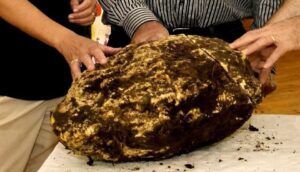
When he set the earth aside, it looked like something yellow and soft. He didn’t initially suspect what it might be, but he didn’t stop to think and took the lumps with him. When the other workers saw the man’s discovery, they were shocked, and one of them immediately knew what it was. He immediately took a knife, cut a piece of the huge lump, and ate it. The others looked shocked, thinking he was crazy. The man knew exactly what he was doing.
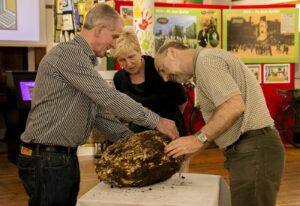
It turned out that the mysterious big lump was actually butter and, above all, it was edible.
Being so marked by the place where he found the butter sphere, the worker called a specialist to tell him more about his discovery. After some research on food, experts have found that it dates back about 2000 years but could still be consumed, is edible.
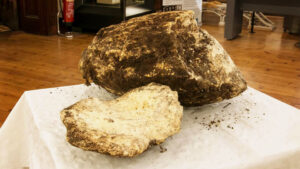
A few thousand years ago, butter was used as an offering at the ceremony for the gods.
This explains the fact that it was kept in the form of lumps. The customs of the time also meant that the butter had to be buried and kept in the ground to keep for as long as possible. We can also explain the fact that it was found in the ground. Probably, 2000 years ago, in the place where the worker found the lumps of butter, it was a normal earth and not mud. That would be the only explanation.
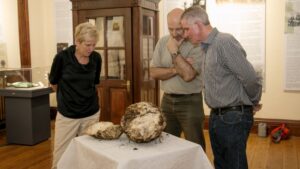
Although it was still edible, dating from such an ancient period, the fate of the butter lump is different. It is currently kept in a special box that benefits from ventilation and cooling at the Cavan County Museum. Researchers hope that it will be preserved for at least another 2000 years.